[Project] Writing a Neural Network from scratch using Numpy
Custom Neural Network Library - Implements Handwritten Digit Recognition
Complete and custom Neural Network library architecture that is modular to any input/output specifications. Can be used similar to how TensorFlow Neural Networks are put together (documented). I have implemented a neural network that can recognise handwritten Digits to 97% accuracy. Current architecture only has Dense layers, but future plans to add more layers (convolutional, etc). This has complete modularity so you can add as many hidden layers as needed.
Currently, modeled to implement a custom handwritten digit recognition algorithm without the use of libaries such as Tensorflow or Pytorch (purely my own library). Numpy is going to be used for vectorization.
- all (lossfunctions, calculation, derivatives etc) are done manually with no assistance from libraries
- Everything is custom - no functions borrowed from external sources (except MNIST data loader and graphing)
Note: current juypter notebook has a pretrained model loaded if you want to look
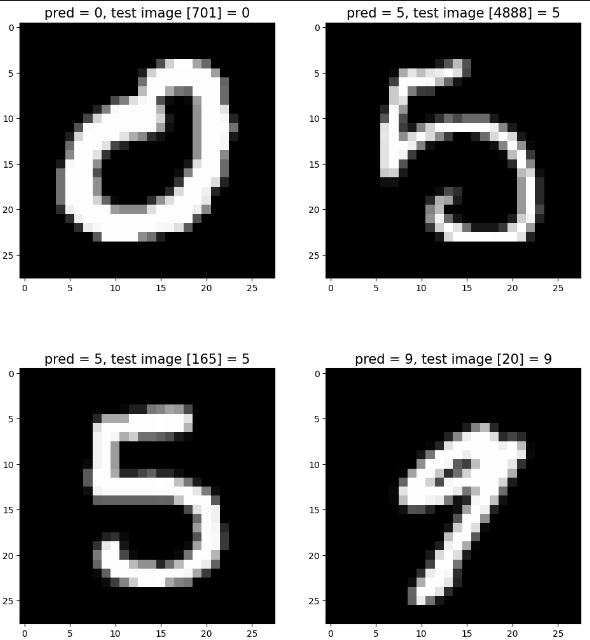
Reason for project - wanted to better understand the underlying operations of a machine learning models, instead of relying on prewritten libraries in tensorflow and pytorch soley
- This hopefully increases my perception in debugging and all aspects of ML
Current model can recognise digits 0-9 (after training has resulted in up to 97.5% accuracy on 10,000 unseen examples)
- indicative of good generalisation
Can reload a previously trained model or train a completely new one (up to preference)
- there is a save and reload feature, otherwise it just initilises with random variables (to then be trained)
Main.ipynb currently models digit recognition as per following
- One neural network with three hidden layers
- DenseLayer(units=25, act_fun=relu)
- DenseLayer(units=15, act_fun=relu)
- DenseLayer(units=10, act_fun=linear)
- The reason the final layer is linear and not softmax is to minimise round off error that can occur (softmax conversion occurs after using the linear output)
- please note softmax values are used in back propogation (even for linear layer)
- loss function is sparse categorical cross entropy
- code for this function can be found in /src/loss_functions
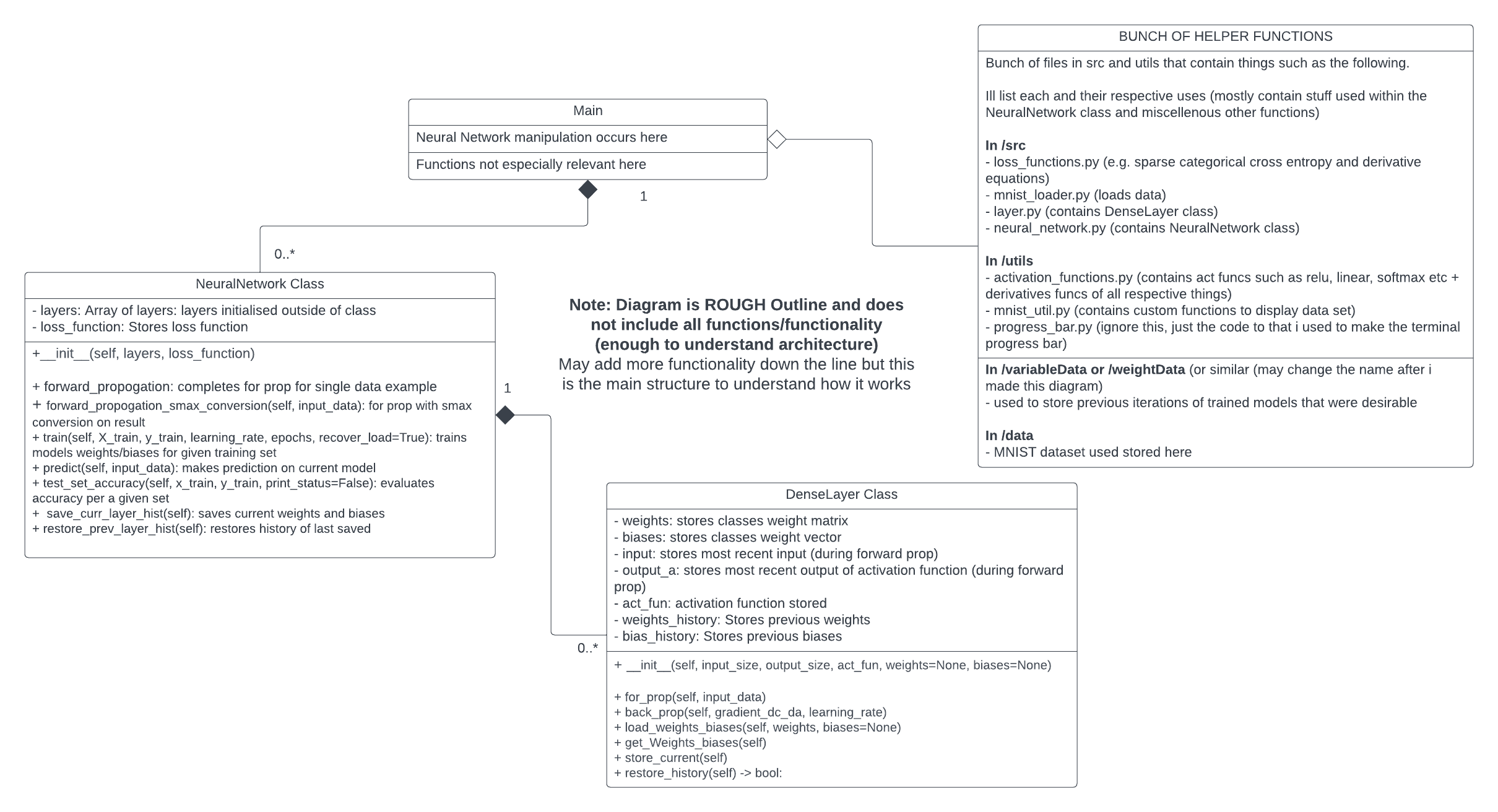
NeuralNetwork class - see UML diagram for function overview/description
- custom, adaptable class (hosts hidden layers)
- can add as many layers using what ever activation function you want
- IS NOT HARD CODED FOR DIGIT RECOGNITION - can do virtually anything you can adapt it too
- in main.ipynb just contains the customisation to work for digit recognition
DenseLayer class - see UML diagram for function overview/description
- initalises its own weigths and biases based on initialisation
- can reload previously trained models
- a lot of back_prop and for_prop functionality occurs within this class
Currently main.ipynb initalises a completely new neural network, but at the end of the document is a commented out way to load previously trained network model (if desired)